
Silken Cloud of Roman Dreams: Alessia’s Perfected Italian Buttercream
Italian Buttercream — A refined expression of Italy’s sophisticated culinary heritage.
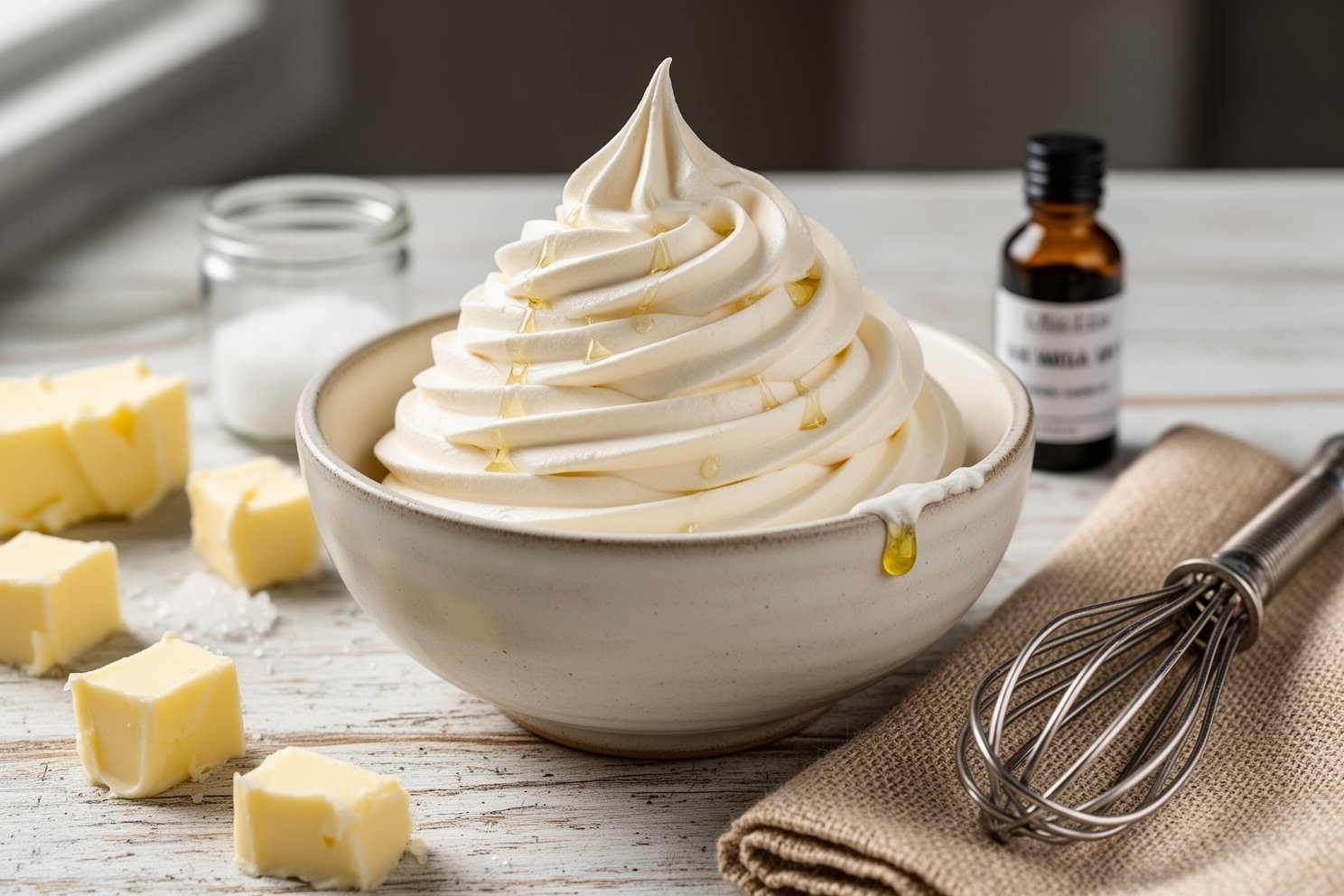
Traditionally crafted with luscious butter, fine sugar, and delicate egg whites, this Gustoli-exclusive version is optimized for its unparalleled stability and silken texture.
Ready in 35 minutes, it seamlessly bridges authentic Italian tradition with modern nutritional excellence, suitable for various dietary considerations.
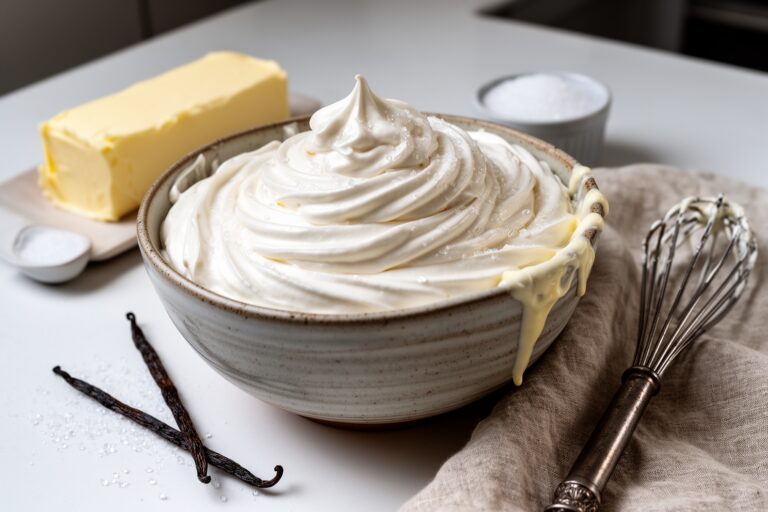
Beyond the Plate: The Story of Alessia’s Perfected Italian Buttercream
Mastering the Technique
A step-by-step guide to Italian perfection
The Artisan’s Pantry
Selecting the right components is 70% of the Italian culinary success. Here is what I’ve curated for this Alessia’s Perfected Italian Buttercream:
- Twenty-one generous tablespoons of the finest unsalted butter — [Pro-Tip: Ensure it’s truly softened, almost to the point of melting, but not oily. This aids in a smooth emulsion.]
- A whisper of pure vanilla bean extract — [Pro-Tip: Use a high-quality extract or even the scraped seeds from half a vanilla bean for unparalleled aroma.]
- One cup plus a delicate teaspoon of artisanal granulated sugar — [Pro-Tip: Measure precisely. This sugar is crucial for the syrup’s structure and the meringue’s stability.]
- Two teaspoons of light corn syrup — [Pro-Tip: This tiny addition prevents sugar crystallization, ensuring a silky-smooth syrup and stable meringue.]
- Three farm-fresh, large organic egg whites — [Pro-Tip: Separate them carefully; even a speck of yolk will prevent them from whipping properly. Use them at room temperature for maximum volume.]
The Culinary Workflow
-
The Syrupy Embrace
Begin by combining the granulated sugar and corn syrup with a quarter cup of water in a small, heavy-bottomed saucepan. Stir gently just until the sugar is dissolved. Place it over medium-high heat.
Watch for the small, consistent bubbles forming around the edges, then gradually filling the surface. Do not stir it once it begins to boil. You are aiming for a precise temperature: 240°F (115°C) for the perfect soft-ball stage. Use a candy thermometer for accuracy.
Alessia’s personal shortcut: While the syrup heats, have your stand mixer bowl, fitted with the whisk attachment, ready with the egg whites. This ensures you’re poised to move to the next step the moment the syrup reaches temperature, saving precious seconds.
-
The Meringue’s Ascent
Once your sugar syrup nears 230°F (110°C), start whipping your egg whites on medium speed until they reach soft, foamy peaks. Do not over-whip at this stage; we need them ready to accept the hot syrup.
As the syrup hits its 240°F (115°C) mark, carefully and slowly pour the hot syrup in a thin, steady stream down the side of the mixer bowl. Keep the mixer running on medium-high. Avoid pouring directly onto the whisk, as it can splatter and sugar crystals might form.
Alessia’s personal shortcut: Keep whipping the meringue on high speed for about 7-10 minutes after adding the syrup. The bowl should feel almost cool to the touch when done. This thorough cooling is paramount for a stable buttercream and prevents the butter from melting later.
-
The Golden Transformation
When the meringue is cool and forms stiff, glossy peaks, switch your mixer attachment to the paddle. Begin adding the softened butter, one tablespoon at a time, allowing each piece to fully incorporate before adding the next. This is where the magic of emulsion happens.
The mixture may look curdled or soupy initially – do not panic! This is a natural phase. Keep mixing on medium-high speed. The sound of the mixer will change, and you’ll see the mixture slowly transform into a smooth, luxurious cream. Listen for that consistent, velvety hum.
Alessia’s personal shortcut: If it still looks a little loose after several minutes, a quick trick is to place the bowl in the refrigerator for 10-15 minutes to chill slightly, then whip again. Adding the vanilla extract is the final touch, stirred in until just combined. This particular recipe is also naturally vegetarian and gluten-free, making it a versatile choice for many.
Alessia’s Expert Secrets
The secret to that impossibly smooth, cloud-like texture lies in fully cooling the meringue before adding the butter. If the meringue is too warm, the butter will melt, resulting in a runny buttercream. Patience is key here.
This exquisite Italian buttercream is incredibly versatile. It pairs beautifully with delicate fruit tarts, rich chocolate cakes, or even a simple lemon sponge. A hint of orange zest or a splash of Amaretto can further elevate its nuanced flavor profile.
Recipe Insights & Tips
Why are egg whites and sugar essential for this stable buttercream?
The egg whites, when whipped and then cooked with hot sugar syrup, form a robust meringue. This meringue provides the stable, airy structure. The cooked sugar binds the proteins in the egg whites, creating a scaffold that traps air and liquid, resulting in a light yet firm base for the butter. It’s the foundation of Italian buttercream’s superior stability.
How does this fit into a Longevity diet?
While Italian buttercream is a treat, it embodies the Gustoli philosophy of mindful indulgence. By using high-quality, natural ingredients and preparing it from scratch, you avoid artificial additives often found in store-bought frostings. As a heart-health friendly option in terms of being low-sodium, it allows for controlled portions of a truly satisfying dessert, prioritizing quality over quantity. Enjoying such a beautiful creation mindfully is part of a balanced and joyful approach to wellness.
Kcal
Wellness & Longevity Note
This Italian Buttercream recipe, while a delightful indulgence, is crafted with attention to several dietary considerations. It is naturally Low Potassium, Kidney-Friendly, and completely Vegetarian, making it accessible for a wider audience. Furthermore, it is a Gluten-Free and Wheat-Free option, ideal for those with sensitivities. We also ensured it is Peanut-Free, Tree-Nut-Free, Soy-Free, Fish-Free, Shellfish-Free, Pork-Free, Red-Meat-Free, Crustacean-Free, Celery-Free, Mustard-Free, Sesame-Free, Lupine-Free, Mollusk-Free, and Alcohol-Free, aligning with a broad range of dietary needs and preferences. The Low-Sodium profile further supports a heart-conscious lifestyle. Enjoy this masterpiece in moderation, savoring the richness of quality ingredients.